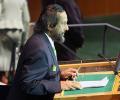
Nobel laureate Rajendra Pachauri, who is head of the United Nations Intergovernmental Panel on Climate Change, on Tuesday made an impassioned appeal to over 100 heads of states and governments to act urgently to mitigate green house gas emission in order to save the planet.

India is among the most vulnerable countries. It could lose 1.7 per cent of its GDP even if the annual mean temperature rises by just a degree.
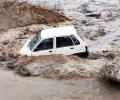
The head of the UN's climate science panel, Jim Skea, has expressed concern over the accelerating pace of climate impacts, saying scientists have been surprised by the speed of temperature rise. Skea attributed the worsening situation to inaction on climate change and highlighted the need for urgent action to reduce greenhouse gas emissions. He also addressed concerns about the scientific messaging and the perception of imposed climate policies, emphasizing the importance of involving societies and people in climate change action.
Rajendra Pachauri, head of the Intergovernmental Panel on Climate Change of the United Nations said the developing countries, including India and China, are unwilling to sign up a new global climate change pact to replace the Kyoto protocol in 2012 as the rich world has failed to set a clear example on cutting carbon emissions. He said rich countrieslike the US, had failed to take the action needed to convince developing nations to sign a deal to help stabilise emissions.

Other measures being considered for 'geo-engineering' the Earth's climate include producing lighter coloured crops and using iron filings in the world's oceans, The Guardian reported, citing leaked papers from the UN science body.
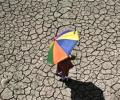
Unless we act dramatically and quickly, science tells us our climate and our way of life are literally in jeopardy, says Kerry.

President Donald Trump has withdrawn the United States from over 60 international organisations, including United Nations bodies and the India-France-led International Solar Alliance, calling the institutions 'redundant' and 'contrary' to America's interests.
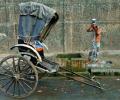
With climate change impacts worsening and affecting the poor and most vulnerable, governments urgently need to scale up adaptation
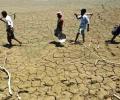
The UNEP Adaptation Gap Report highlights gaps worldwide in finance, technology, and knowledge.

Worse still, the cities ranked second, third and fourth for their poor air quality are also in India.

Pachauri was admitted to Escorts Heart Institute in the national capital where he underwent open heart surgery and was put on life support on Tuesday, sources said.

'The Paris Conference is a decisive meeting on climate change.' 'Negotiating an agreement between 196 countries is indeed a challenge.' 'If we go beyond 2°C, the consequences will be extremely difficult to deal with.'The poor are the most vulnerable to the impact of climate change.'
Developing economies will have to come forward to devise their own technologies for the energy sector rather than looking up to the developed nations, R K Pachauri, chief of United Nations Intergovernmental Panel on Climate Change said in New Delhi on Monday. In his first public appearance after the organisation he headed won the Nobel Peace Prize this year, Pachauri said that there is a clear line of distinction between the energy needs of developing and developed nations.

'The food security along the coastal region will be severely affected.'

Buffeted by allegations of sexual harassment, R K Pachauri on Tuesday quit as chairman of United Nation's prestigious Intergovernmental Panel on Climate Change, whose meeting here he has avoided.

I am inclined to believe that the Venezuela adventure is not an indication of American strength, alas, but rather of American weakness, points out Rajeev Srinivasan.
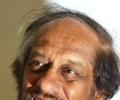
Pachauri was responding to queries on Monday about how he intended to implement several recommendations made by the InterAcademy Council, which conducted a review of the working of the IPCC following widespread criticism stemming from erroneous conclusions in its fourth report.
Leading British newspaper Daily Telegraph on Friday apologised for publishing an article about United Nation's climate body chairman R K Pachauri, accusing him of making a fortune from his links with 'carbon trading' firms. The international publication had been running a campaign since last year against the chief of the Nobel Prize-winning Intergovernmental Panel on Climate Change, who has strongly rubbished the allegations and even issued several legal notices.
Supporting India's quest for nuclear power, United Nations climate panel's chief scientist R K Pachauri has said that country should pursue it to contain emission and meet energy needs.

Gore, who was US President Bill Clinton's deputy in 2000, made the 2006 Oscar-winning documentary An Inconvenient Truth, after which he was seen as a champion of environmental issues and climate change.

The UN made it clear that it will not conduct any inquiry into accusations of sexual harassment against R K Pachauri

At a virtual press conference to launch the report, Inger Anderson, Executive Director, United Nations Environment Programme, said, "Climate change is here and now. No one is safe. Despite warnings from so many years, the world did not listen. We need to act now. Reducing greenhouse gas emissions will not only limit climate change but also reduce air pollution."

'Keeping the global temperature below not just 1.5 degree Celsius, even 2 degree Celsius is beyond our reach now. Both are impossible.'

The average global temperature between January and October has been 0.68 degrees Celsius higher than the 20th century's average global temperature of 14.1 degree C.
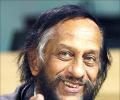
Pachauri is scheduled to speak in China from August 22-28.Thereafter, he is scheduled to attend a meeting in Tokyo.

The 2C target was always somewhat arbitrary as a threshold for preventing the worst effects of global warming in the form of rising sea levels and more severe and frequent storms, floods and droughts.

Heatwaves with higher humidity levels can be more perilous because the air cannot efficiently absorb excess moisture. This limitation restricts the human body's ability to evaporate sweat and affects the moisture content of certain infrastructure like evaporative coolers.

The Aam Aadmi Party's government's policies on water and electricity are well intended but not the best way to achieve the desired goals as the supply of over 600 litre of free water to Delhi residents may end up in a lot of wastage, Directer General of The Energy and Resources Institute R K Pachauri has warned.

COP 21 is about how much carbon space is left and who gets how much of that space
.jpg)
Climate change and US-India collaborations in renewable energy resources will be up for discussion at the US-India energy summit coinciding with Prime Minister Narendra Modi's visit to Washington, DC, later this month, reports Aziz Haniffa.

Since the US, the second biggest emitter of greenhouse gases after China, has shifted in a major way to shale gas, the focus of global environmentalists' ire has fallen on India, which is the third biggest emitter, reports Darryl D'Monte.
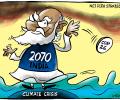
Politicians and Twitter warriors around the globe have a new buzzword among them: Net zero. Everyone appears to be keen to state their commitment to net zero, with India providing an outlay of Rs 35,000 crore to achieve energy transition and net-zero objectives in its Budget for FY24, even as the latest and final report by the United Nations' Intergovernmental Panel on Climate Change (IPCC) warned that current efforts are not enough to curb global warming. A number of small factory owners and businesses, however, have pointed out that the transition to net-zero emissions will cost them hugely.

'For lakhs of people in the flood-afflicted state, battling against the elements is taking a huge toll. This is the time of the year that apples ripen, rice starts being harvested and preparations start in full swing to put aside some of the food stocks for the long winter months ahead. At this moment, though, people there believe if they can succeed in coming out of this calamity in one piece they will have won the war,' says Rashme Sehgal.
 © 2026 Rediff.com - Advertise with us - Disclaimer - Privacy Policy - Sitemap - Feedback - About us - Terms of use - Grievances